Managing Noise & Preventing Hearing Loss
Hearing loss is permanent and largely silent in onset. 85 dB(A) average over 8 h, or 140 dB(C) peak — either trigger is a problem. Eliminate or engineer first; PPE last.
- Exposure standard: LAeq,8h = 85 dB(A) OR LCpeak = 140 dB(C).
- Rule of thumb: if you must raise your voice at 1 m, noise > 85 dB(A).
- Audiometric testing: baseline within 3 months of starting; periodic at least every 2 years.
- Ototoxic chemicals (lead, mercury, manganese, organic solvents, CO) multiply hearing-loss risk — combined exposures matter.
- "Buy quiet" — specify ≤ 80 dB(A) emission for new plant.
1. Exposure standard (Reg 56)
| Metric | Limit |
|---|---|
| LAeq,8h (8-h equivalent A-weighted) | 85 dB(A) |
| LCpeak (C-weighted peak) | 140 dB(C) |
Extended-shift adjustments
- 10–14 h: +1 dB
- 14–20 h: +2 dB
- 20+ h: +3 dB
Both metrics apply simultaneously — exceeding either triggers control + audiometry.
2. Risk factors
- Noise level + exposure duration combined (LAeq,8h).
- Vibration — hand-arm (chainsaws, breakers, grinders); whole-body (vehicles, mobile plant).
- Ototoxic chemicals:
- Solvents: toluene, xylene, n-hexane, carbon disulphide, styrene.
- Metals: lead, mercury, manganese, arsenic, organic tin.
- Other: CO, hydrogen cyanide, organophosphates, paraquat, acrylonitrile.
- Some medications (anti-cancer, anti-inflammatory, antibiotic, anti-malarial; quinine, salicylates).
- Combined exposures dramatically elevate risk — e.g. lead + 80 dB(A) noise behaves worse than 90 dB(A) alone.
3. Hazard identification
Rule of thumb: must raise voice to communicate at 1 m → likely > 85 dB(A).
Systematic ID:
- Walk-through; observe and ask workers.
- Manufacturer noise data — target ≤ 80 dB(A) LAeq emission, ≤ 88 dB sound power for new plant.
- Past audiometry results, hearing-loss workers' compensation claims.
- Hazard checklist (source Appendix C): powered tools, impacts/explosives, PPE use, tinnitus complaints, ringing ears.
4. Noise assessment
Who — competent person (AS/NZS 1269.1).
When
- After hazard identification.
- When sources change.
- After implementing controls (verify they worked).
- After complaints.
How
- Measure typical work shift; per-task levels + durations.
- Integrating sound level meter (10–20 cm from ear) or personal dosimeter for mobile workers.
- Measure individual sources separately AND combined (background: ventilation, compressors, pumps).
- Use Ready Reckoner (Appendix D of source) to combine multiple tasks.
- Apply extended-shift correction.
- Record in assessment report.
5. Hierarchy of control for noise
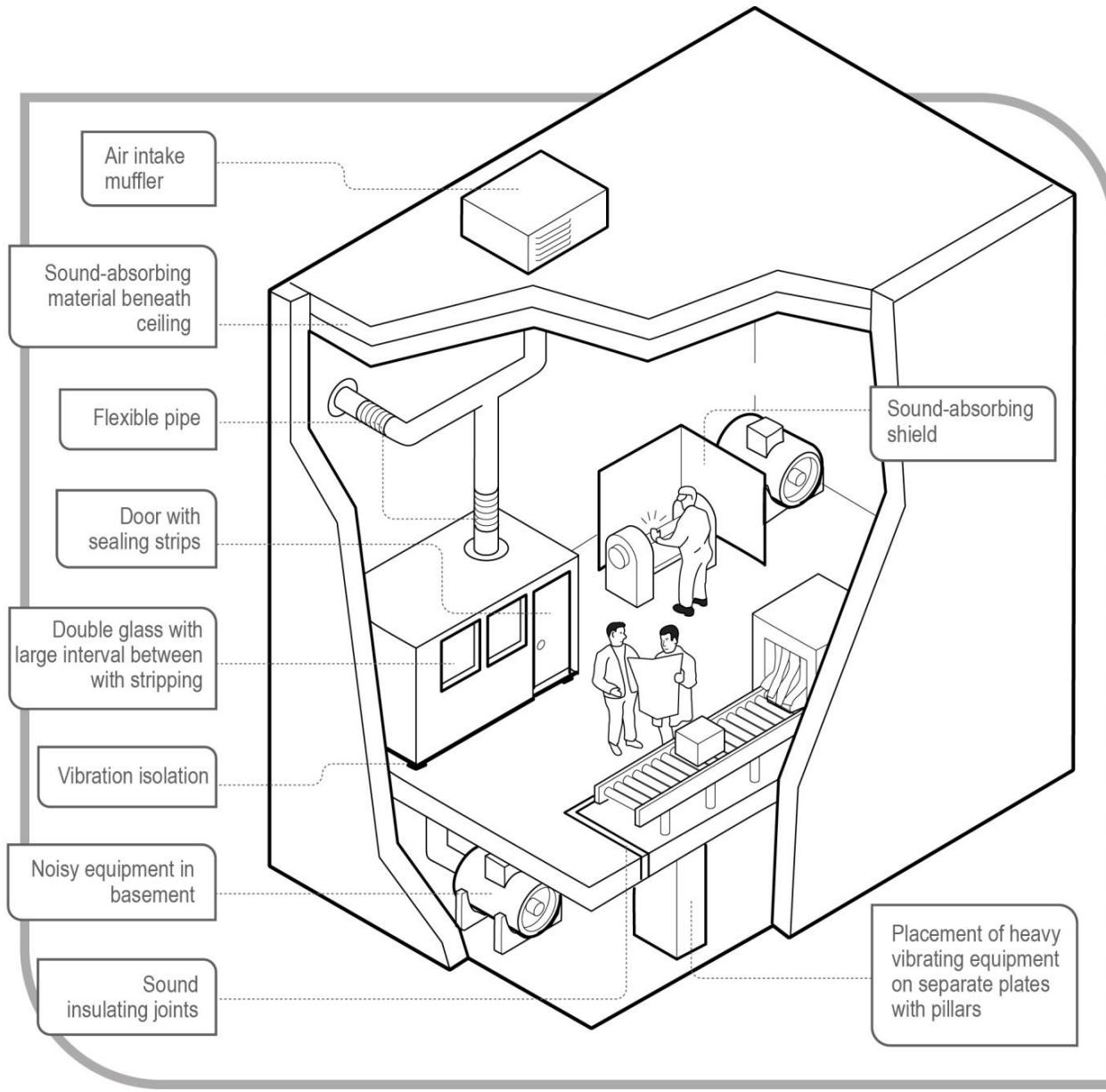 Figure 1 — Multiple controls in a noisy facility: source enclosures, distance, sound-absorbent surfaces, barriers. Each layer adds dB.
1. Eliminate
- Cease use of noisy machinery.
- Redesign process — weld instead of rivet; press instead of hammer.
2. Substitute / Isolate / Engineer
- Buy quiet plant (compare emission data).
- Distance — 6 dB reduction per doubling of distance (free field).
- Barriers, enclosures, sound-absorbing surfaces, remote operation.
- Mufflers / silencers on exhausts and compressed-air outlets.
- Damping (rubber) on panels; vibration-isolation mounts on heavy equipment.
- Impact absorption — cushioned surfaces, foam-lined ducts.
- Material substitution (metal → plastic).
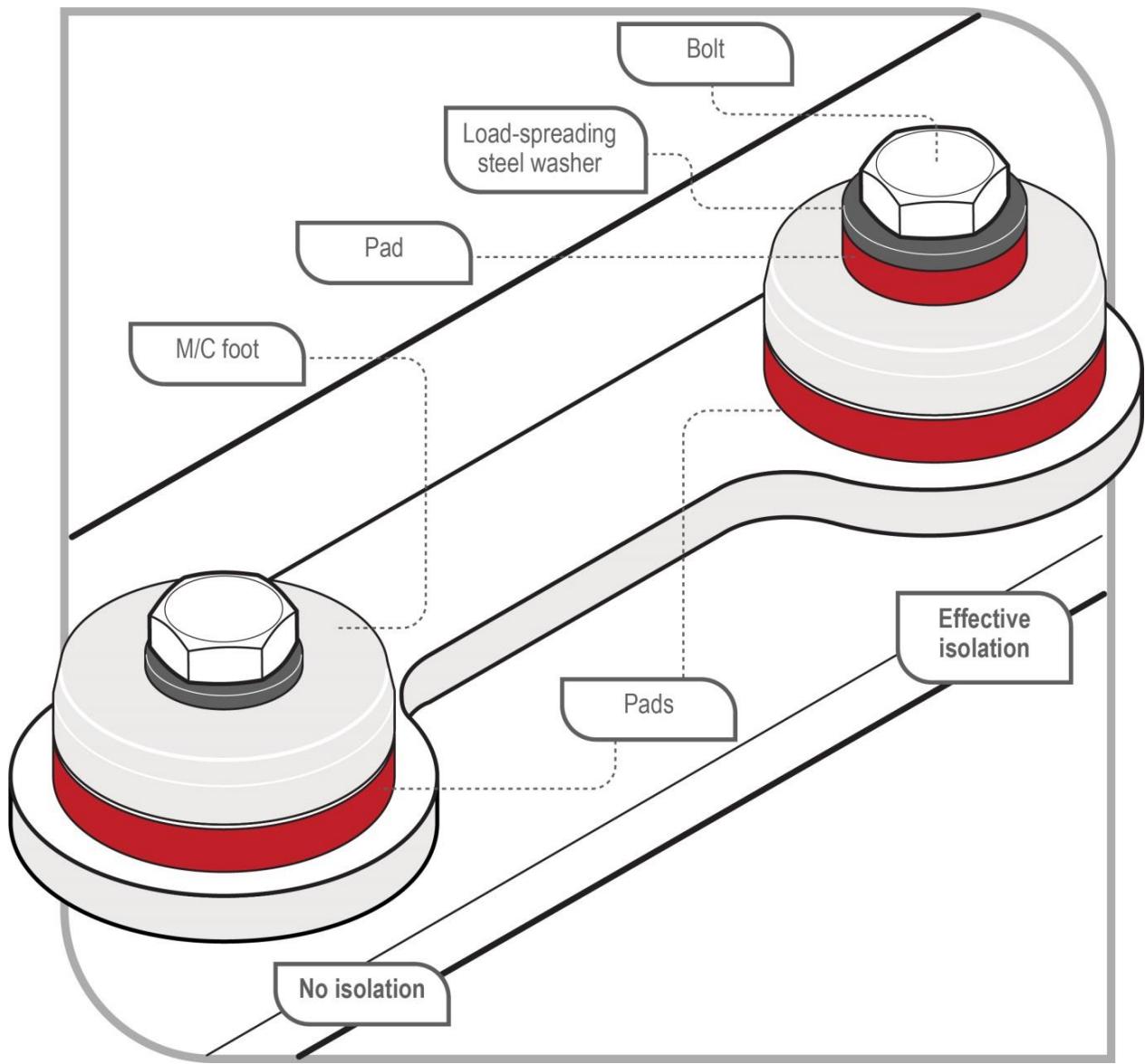 Figure 2 — Effective vs ineffective vibration isolation. Bolt "short-circuiting" the isolation mount transmits vibration straight through. Detail matters.
3. Maintenance — fix worn bearings, blunt blades, loose parts, air/steam leaks; maintain isolation mounts, seals.
4. Administrative
- Schedule noisy work when few workers present.
- Notify workers in advance.
- Rotate between noisy / quiet tasks; limit cumulative exposure.
- Restrict non-essential personnel from noisy areas.
- Provide quiet rest areas.
- Signage at noise zones.
5. PPE — hearing protection devices (HPDs)
- Earplugs / earmuffs; class 1–5 rating to LAeq exposure (90 → 110+ dB(A)).
- PCBU verifies correct class, fit, and consistent use.
- Workers must use as instructed; no intentional misuse / damage.
6. Distance, isolation, damping — three key engineering moves
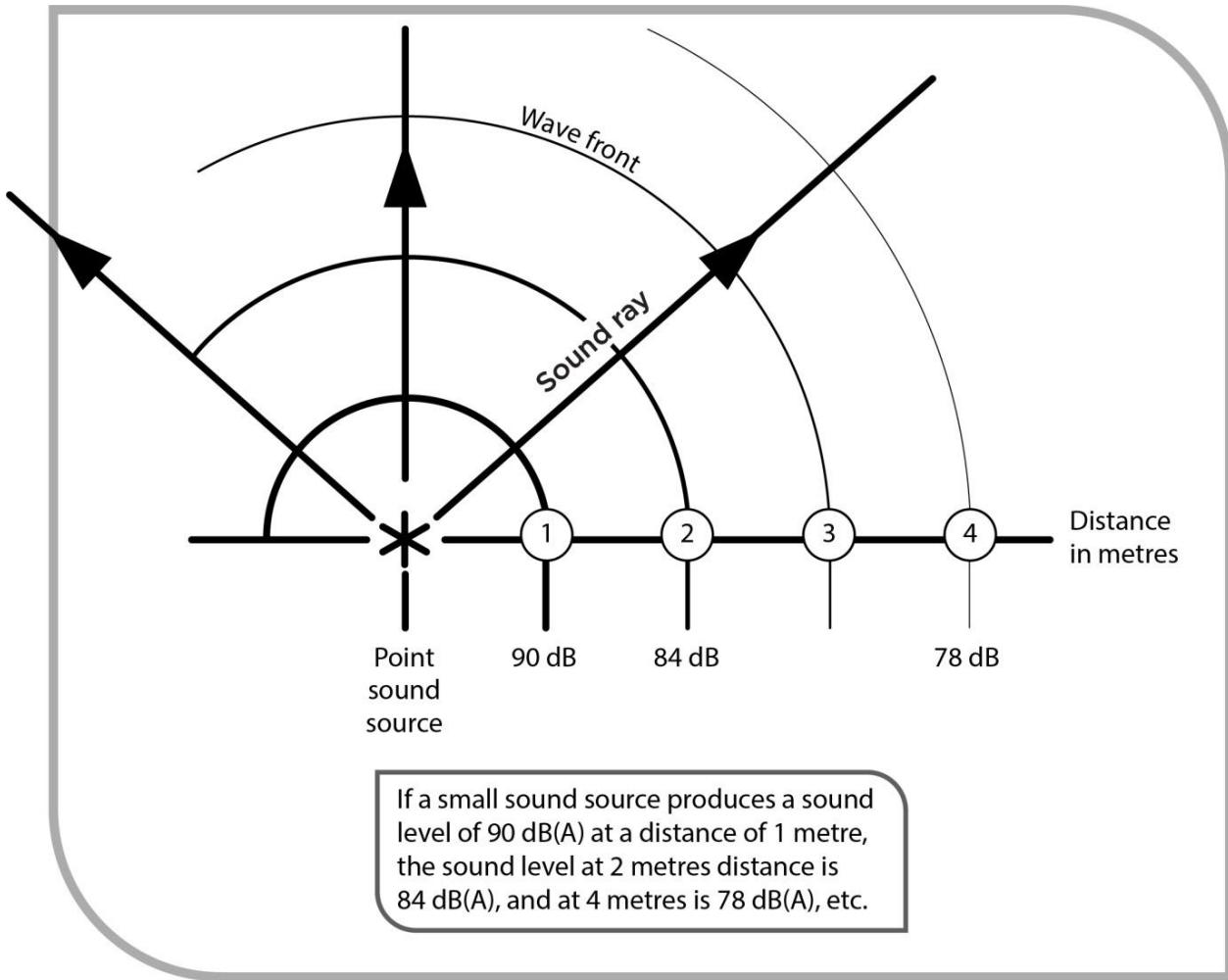 Figure 3 — Sound reduces ~ 6 dB per doubling of distance in a free field. Even moving a worker 4 m further from a 95 dB(A) source can drop them below the standard.
7. Audiometric testing (Reg 58)
Mandatory for workers required to frequently use HPDs for noise > 85 dB(A).
| Test | Cycle |
|---|---|
| Baseline | Within 3 months of commencing work (before hazardous exposure) |
| Follow-up | At least every 2 years; more often if LAeq,8h ≥ 100 dB(A) |
| Timing | Well into shift (detects temporary threshold shift) |
| Standard | AS/NZS 1269.4 |
| Result handling | Worker receives written explanation; de-identified group data to H&S reps |
If a threshold shift is detected:
- Review controls.
- Verify HPD class, fit, consistent use.
- Consider job modification — volume controls, acoustic meeting areas, visual warnings, alternative tasks.
Recommended (not mandatory) monitoring if exposed to ototoxic substances > 50% exposure standard, or combined vibration + noise (LAeq,8h > 80 dB(A) / LCpeak > 135 dB(C)).
8. Construction-specific examples
Common high-risk tools:
- Pneumatic / electric breakers, grinders, drills, chainsaws.
- Lawnmowers, brush-cutters, rivet guns.
- Compressors, generators.
- Rock drills (~ 120 dB(A)).
Multiple tools concurrently — cumulative exposure rises rapidly. Plan staging so high-noise tasks don't overlap or share workspace.
9. Records & training
- Noise-assessment reports.
- Audiometry results (baseline + periodic) — individual confidential; de-identified shared.
- Maintenance logs (worn equipment progressively becomes noisier).
- HPD class / fit-test records.
- Procurement records demonstrating "buy quiet" (where applicable).
- Training: workers and supervisors understand exposure standard, controls, HPD selection / fit / use.
10. Common pitfalls / quick wins
Do
- Establish a "buy quiet" procurement policy. Ask for emission data on every quote.
- Position workers further from sources where layout allows — distance is free.
- Rotate operators on the loudest tools.
- Service damping mounts and seals — they degrade.
- Issue HPDs with the correct class (not just "any earmuff"); fit-test.
- Run audiometry on schedule; act on shifts before they become permanent.
- Treat ototoxic chemical exposure as a noise multiplier.
Don't
- Rely on HPDs as the primary control. Engineering and admin first.
- Ignore impact noise — peak limits matter even when LAeq looks fine.
- Use rule-of-thumb in lieu of measurement once you've identified a hazard.
- Treat audiometry as an HR formality — it's a control-effectiveness signal.
- Let workers self-select HPD class — let the assessment determine it.
11. Cross-references
- See also: hazardous_manual_tasks (vibration), abrasive_blasting (high noise), welding_processes (plasma), managing_risks_of_plant (plant procurement)
- Foundations: risk_management_process
- Glossary (LAeq, HPD class, ototoxic): glossary_and_key_concepts
Source: model_code_of_practice-managing_noise_and_preventing_hearing_loss_at_work-nov24.pdf (Safe Work Australia, model Code of Practice, CC-BY-NC 4.0). Edition: November 2024 (supersedes Jul 2020 GHS Rev 7 amendment). Exposure standard (85 dB(A) / 140 dB(C)) and audiometric requirements carried forward unchanged. Last verified against SWA: 2026-04-28.